
The Reserve Bank of India kept interest rates on hold at 7.50 per cent.

The country's exports rose by about 6 per cent to a "record" $447 billion during 2022-23 on account of healthy growth in the outbound shipments of sectors such as petroleum, pharma and chemicals and marine, Commerce and Industry Minister Piyush Goyal said on Thursday. The country's imports also grew by 16.5 per cent to $714 billion in 2022-23 as against $613 billion in 2021-22. He said that the exports of goods and services together scaled "new heights" and has increased by 14 per cent to $770 billion in 2022-23 as against 676 billion in 2021-22.
The Reserve Bank of India's rate-setting panel will go for a 0.35 per cent hike in the key repo rate at its meeting next week, an American brokerage said on Wednesday. The hike will be accompanied by a change in the policy stance to "calibrated tightening", Bofa Securities said in a report published ahead of the Monetary Policy Committee (MPC) resolution which is set to be announced on August 5. RBI has hiked the rate by a cumulative 0.90 per cent in two tightening moves in May and June, responding to the runaway headline inflation which has consistently overshot the upper end of the target set for the central bank for many months.

India's leading capital goods and engineering firms are in the midst of one of their busiest seasons, with the combined orderbook surging past Rs 8 trillion in value. As on September 30, 2023, 13 of India's top 15 listed capital goods and engineering firms, for which data for the September 2023 quarter was available, had a total orderbook worth Rs 8.45 trillion - a number unseen at least since 2018-19. "This intuitively looks like an all-time high factoring in inflation," said Anupama Arora, a senior independent analyst who tracks the capital goods sector.

If oil prices rise, the government would face an uncomfortable political decision.

Firms that should borrow abroad do not do so enough, and those that should not borrow abroad do.

The benchmark indices have rallied 28 per cent this year, while the broader market has outperformed

On growth, the Governor said the prospects in the last few months have improved.

Moody's listed six agenda on the list of pending reforms -- land acquisition Bill, labour law reforms, significant infrastructure investment, tangible benefit from Make in India initiative, tax administration and PSU bank reforms
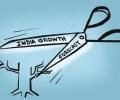
Moody's Investors Service on Thursday slashed India's economic growth projection for 2022 to 7.7 per cent, saying that rising interest rates, uneven monsoon, and slowing global growth will dampen economic momentum on a sequential basis.

The Reserve Bank of India on Friday raised the benchmark lending rate by 50 basis points to 5.40 per cent to tame inflation.
Modi will also need to reconcile market demands with those from forces within his own administration

Analysts at Bank of America Merill Lynch said that fears of inflation getting "generalised" are overdone, as only two sub-categories of fuel and light and housing (accounting for 22 per cent of the basket) have seen a price-rise above the headline 5.2 per cent.

Although there is headroom for further monetary policy action, at this juncture it is important to keep our arsenal dry and use it judiciously: RBI's Das.
As the MPC is mandated to target CPI inflation rate at 4 plus minus 2 per cent, any measurement error in CPI is likely to have grave consequences for monetary policy.

'Who has given how much money to which party, the people of India must know this fact.'

The critical information in the first quarter (Q1) gross domestic product (GDP) data relates to the proximity of real and nominal GDP growth rates at 7.8 per cent and 8 per cent, respectively. The implicit price deflator (IPD)-based inflation is only 0.2 per cent. This phenomenon has repeated after fifteen quarters.

RBI's surprise rate cut has revived sentiments of India Inc.

The World Bank on Tuesday revised upwards its GDP growth forecast for India to 6.9 per cent for 2022-23, from 6.5 per cent earlier.

Factory output, measured in terms of Index of Industrial Production, showed an improvement mainly because of an uptick in mining and manufacturing production and larger offtake of capital goods.

Raghuram Rajan is correct -- the RBI's monetary response to inflation in the past has been too weak.

Rating agency ICRA said on Tuesday that a remarkable aspect of the Reserve Bank of India's Monetary and Credit Policy for the First Half of 2004-05 is its timing.

What's different this time is that global financial stress -- which has its genesis in four policy choices made in recent years -- is juxtaposed with a more resilient real economy, observes Sajjid Z Chinoy, chief India economist at J P Morgan.

Will seek to bring inflation to the mid-point: Rajan

Citi, HSBC and UBS etc have already cut their market targets.

Reserve Bank of India (RBI) on Friday kept the benchmark interest rate unchanged at 4 per cent and decided to continue with its accommodative stance despite rising inflation. This is the 11th time in a row that the Monetary Policy Committee (MPC) headed by RBI Governor Shaktikanta Das has maintained the status quo. RBI had last revised its policy repo rate or the short-term lending rate on May 22, 2020 in an off-policy cycle to perk up demand by cutting the interest rate to a historic low.

Is it a case of poor targeting of a welfare scheme, or is it a reflection of the government's desire to expand the scope of this benefit to secure greater electoral dividends? asks A K Bhattacharya.

Sticking onto his stance of calling the allegations against him 'false', AAP leader Manish Sisodia in his resignation letter said that it is unfortunate that despite working with honesty and truthfulness continuously for eight years, corruption charges are being levelled against him.

India's economy is not like Western ones, and thus needs restrained fiscal policy even during a recession, says Ajay Shah.

'You may see some movement indicating a simpler tax regime with less exemptions but with fewer tax rates making life simpler for taxpayers.'

The Asian Development Bank (ADB) on Wednesday slashed India's GDP growth forecast for FY23 to 7 per cent from the earlier estimate of 7.2 per cent mainly on account of higher inflation and a tight monetary policy. India's economy grew 13.5 per cent year-on-year in the first quarter of 2022-23, reflecting strong growth in services, ADB said in its second supplement to Asian Development Outlook Report 2022 (ADO 2022). "However, GDP growth is revised down from ADO 2022's forecasts to 7 per cent for FY2022 (ending March 2023) and 7.2 per cent for FY2023 (ending March 2024) as price pressures are expected to adversely impact domestic consumption, and sluggish global demand and elevated oil prices will likely be a drag on net exports," ADB said.

The year 2015 is turning out to be very different from 2014.

Reserve Bank of India Governor Shaktikanta Das on Friday said the country's economy is an island of stability despite two Black Swan events and multiple shocks. "In an ocean of high turbulence and uncertainty, Indian economy is an island of macroeconomic and financial stability," Das told reporters during the post policy press conference. He said the financial stability, macroeconomic stability and resilience of growth is being witnessed despite two Black Swan events happening one after the other and multiple shocks.

Finance Minister Nirmala Sitharaman will be presenting her fifth Budget that may do a tightrope walk between staying fiscally prudent and meeting general public expectations of lower taxes and a wider social security net, while at the same time firing the engines of the economy.

Improved credit profile may make you eligible to transfer your existing home loan to another lender at a much lower rate.

It has been a choppy calendar year 2022 (CY22) for global financial markets amid the spectre of rising inflation that led most central banks, especially the US Federal Reserve (US Fed), to tighten their monetary policy. Most equity indices across the globe have seen a sharp fall from their respective peak levels in this backdrop. FTSE India, for instance, has corrected 16 per cent from its October peak.
The Foreign Trade Policy Supplement released by the commerce ministry on Friday extended the (Duty Entitlement Pass book) DEPB scheme till May 2009. The exports for 2007-08 will exceed $155 billion, Commerce and Industry Minister Kamal Nath said. The government has set an export target of $200 billion for the year 2008-09.

Inflation target remains 5% for January 2017.

Pranjul Bhandari, Chief India Economist, HSBC, speaks about a range of issues ranging from inflation, to how Goods and Services Tax and land acquisition bills can help India hit double digit growth, and her impressions about economic growth in the last one year after Narendra Modi took over as India's Prime Minister.

A piece of slightly negative news can cause a serious setback, warns Debashis Basu.
